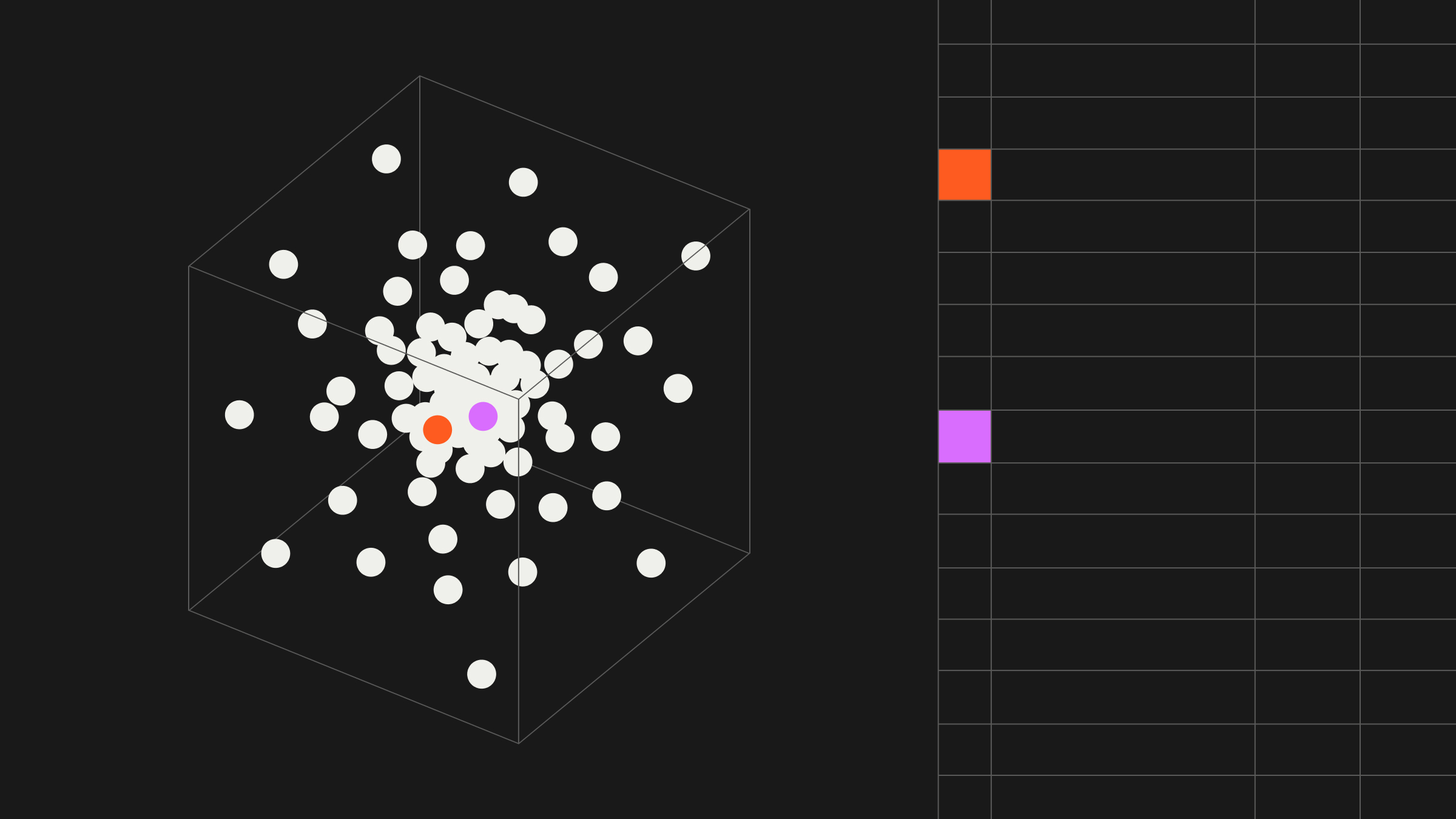
Embeddings are central to personalized recommendations: dense vector representations of users and items that capture behavioral patterns and semantic relationships.
Teams can move beyond ranked results to directly access and leverage these embeddings, enabling use cases like similarity search, advanced analytics, churn prediction, and custom machine learning models.
This article covers why embeddings matter, what you can do with them beyond a final ranked list, and why generating and serving them reliably is its own engineering problem.
Beyond Predictions: Understanding the “Why”
Rank and similarity APIs return optimized lists, but embeddings expose the structure a model has learned. That matters when you want custom similarity, analytics, downstream ML features, or qualitative debugging rather than only the top-K results.
Modern recommendation models learn dense vector representations, or embeddings, for users and items. Proximity in that space reflects similarity: related items cluster together, and users with similar tastes land near each other. Building and maintaining those representations in production is often the hard part.
Unlocking Advanced Use Cases with Embeddings
Accessing raw embeddings opens up powerful possibilities:
- Custom Similarity Engines: Calculate cosine similarity (or other distance metrics) between item embeddings to build your own “Similar Items” features with custom logic or filtering not available in the standard similar_items API. Do the same for user embeddings to find “Similar Users.”
- Enhanced Analytics & Visualization:
- Clustering: Apply clustering algorithms (like K-Means) to user embeddings to discover natural user segments based on learned behavior, rather than just demographics.
- Visualization: Use dimensionality reduction techniques (t-SNE, UMAP) on item or user embeddings to create 2D maps visualizing relationships, identifying niches, or understanding market structure.
- Featurization for Downstream ML: Use learned embeddings as input features for other machine learning models:
- Churn Prediction: User embeddings often capture behavioral patterns predictive of churn.
- Lifetime Value (LTV) Prediction: Embeddings can encapsulate engagement levels correlated with LTV.
- Cohort Analysis: Analyze how embeddings differ across predefined cohorts or how they evolve over time.
- Targeted Marketing: Use embedding similarity to find users similar to high-value customers for lookalike campaigns.
- Advanced Recommendation Strategies: Implement custom recommendation algorithms (e.g. content-based filtering using item embeddings or hybrid approaches) on top of learned embeddings.
- Model Diagnostics: Inspect embeddings to qualitatively understand what the model has learned about specific items or users.
The Standard Approach: The High Cost of DIY Embeddings
Generating effective user and item embeddings that capture complex relationships requires significant effort:
Step 1: Data Aggregation and Preparation
- Method: Gather vast amounts of user interaction data (clicks, views, purchases, ratings, etc.) and potentially rich user/item metadata (text descriptions, categories, user attributes).
- Implementation: Build robust data pipelines to collect, clean, and process this data from various sources.
- The Challenge: Requires significant data engineering effort and infrastructure to handle large volumes of diverse data reliably.
Step 2: Choosing and Training Embedding Models
- Method: Select appropriate embedding techniques. Options range from classic matrix factorization (ALS, SVD) to more advanced methods like Word2Vec variants (Prod2Vec), graph embeddings, or state-of-the-art deep learning models (using RNNs, Transformers like BERT/GPT on interaction sequences or content).
- Implementation: Requires deep machine learning expertise to choose the right architecture, configure hyperparameters, and implement the training process using frameworks like TensorFlow or PyTorch.
- The Challenge: Model selection and training demands specialized ML skills. Training advanced models also requires substantial computational resources (GPUs) and time.
Step 3: Building Serving Infrastructure
- Method: Once embeddings are generated (often periodically via batch training), they need to be stored and made accessible for downstream tasks.
- Implementation: Requires setting up storage (e.g., databases, vector databases like Pinecone/Weaviate/Milvus for similarity search) and building APIs to retrieve embeddings or perform similarity lookups efficiently.
- The Challenge: Requires managing storage infrastructure, potentially specialized vector databases, and building low-latency serving APIs. Keeping embeddings fresh requires rerunning complex training pipelines regularly and quickly.
Step 4: Integrating Multiple Signals
- Method: The best embeddings often combine signals from user behavior, item content (text, images), and user attributes.
- Implementation: Designing models and pipelines that effectively fuse these different data modalities adds significant complexity to both training and data preparation.
- The Challenge: Advanced modeling techniques and intricate data engineering are needed in order to truly blend different signals into a semantically sensible embedding space.
Accessing Embeddings in production: A Conceptual Example
Let’s illustrate how to retrieve embeddings for a specific user and a set of items.
Goal: Get the vector representations for USER_777 and items ITEM_A, ITEM_B.
Conclusion
User and item embeddings are one of the most useful artifacts a ranking system produces. They power similarity search, clustering, cold-start heuristics, and downstream analytics. The hard part is not retrieving a vector once; it is training, versioning, and serving representations that stay aligned with your live ranking models.